

ACROA
A contract agent that reads every obligation and never guesses a date
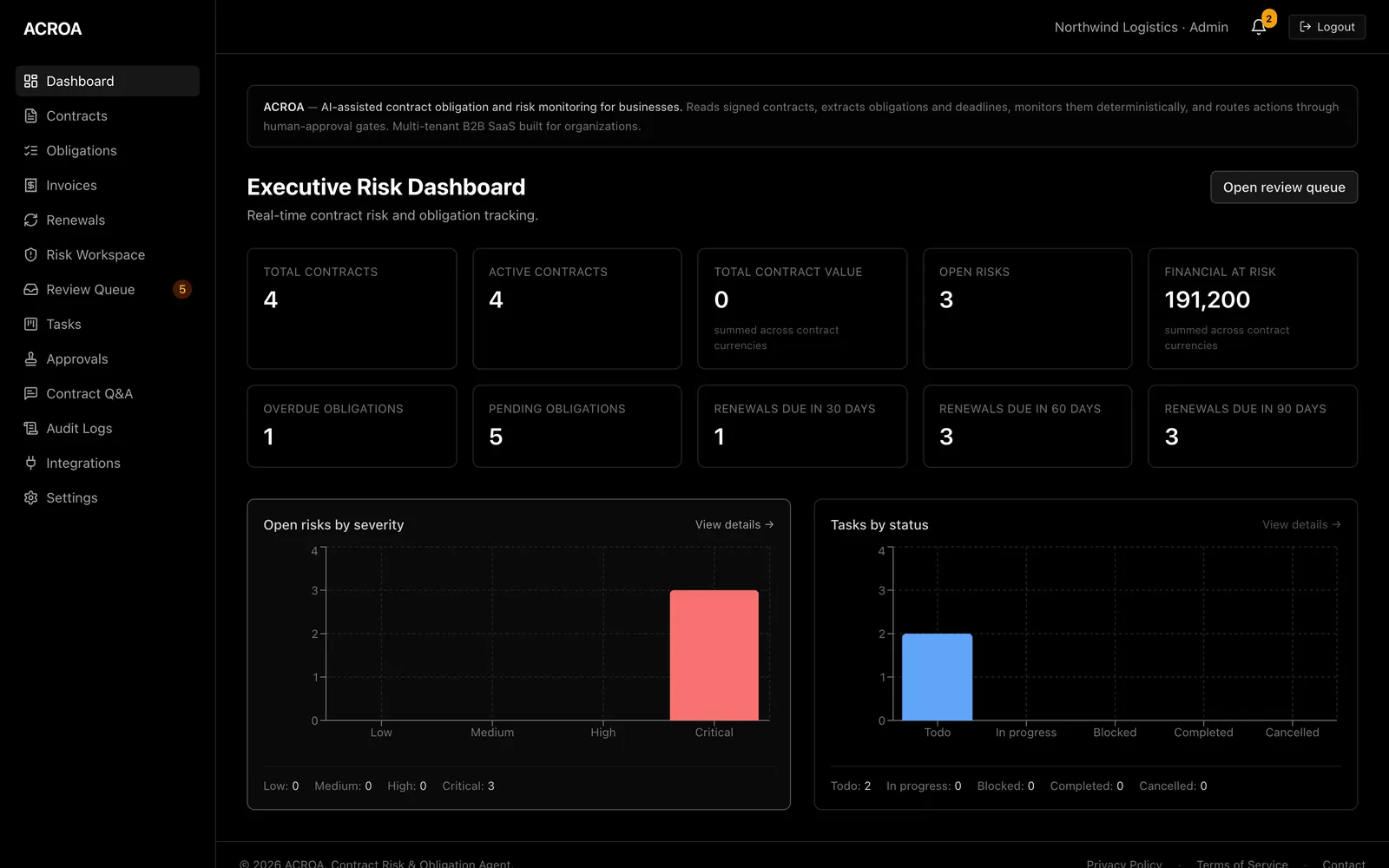
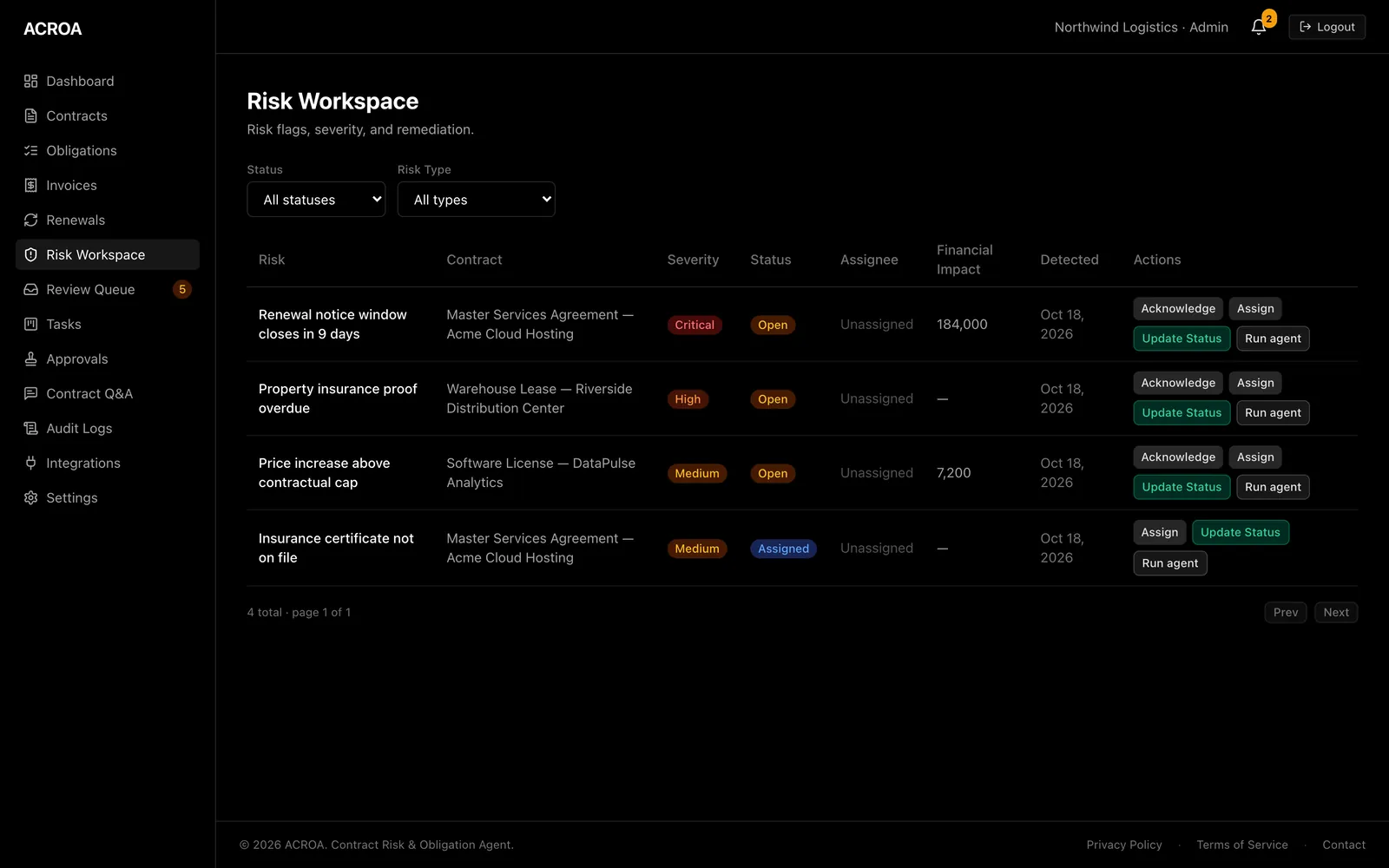
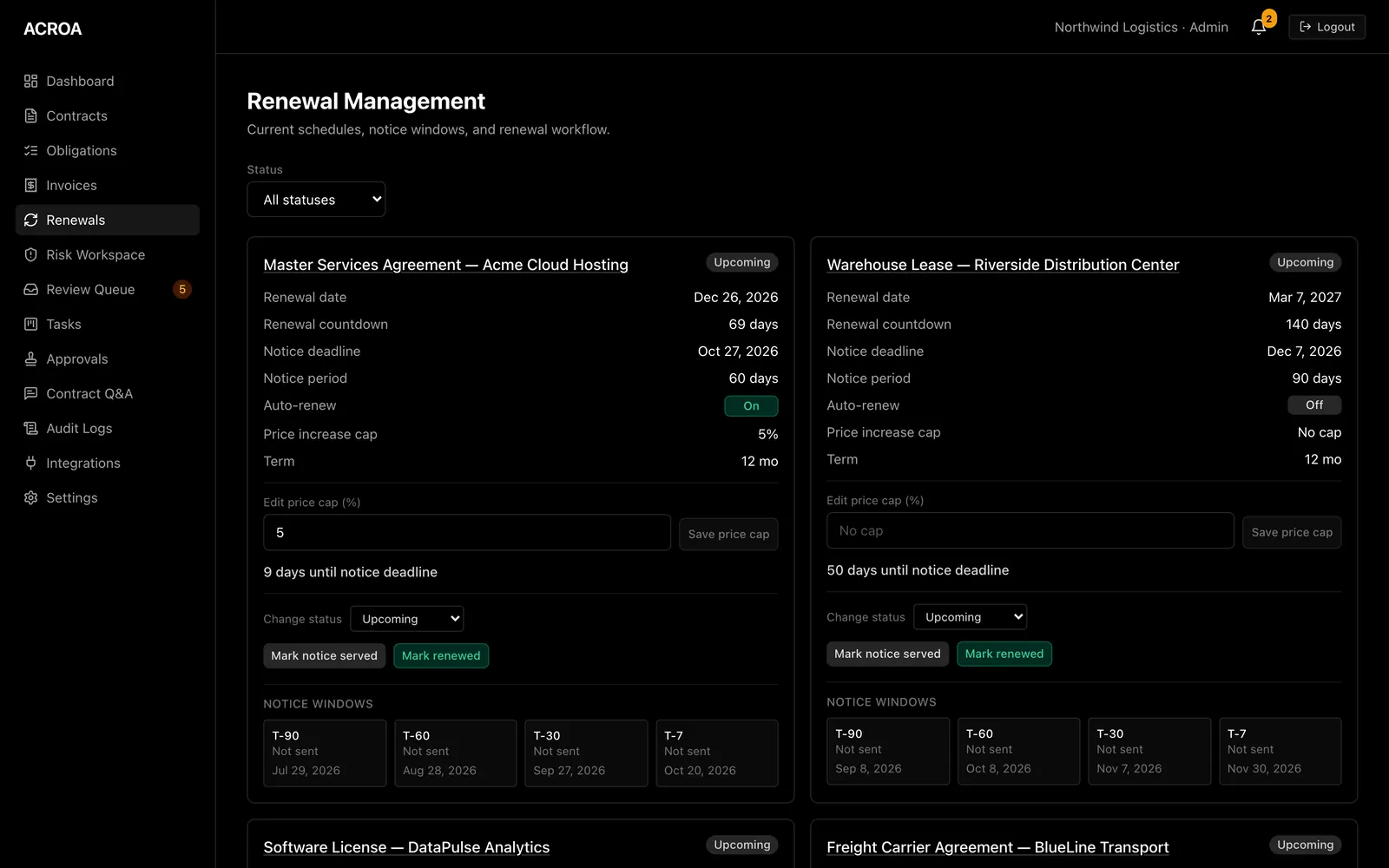
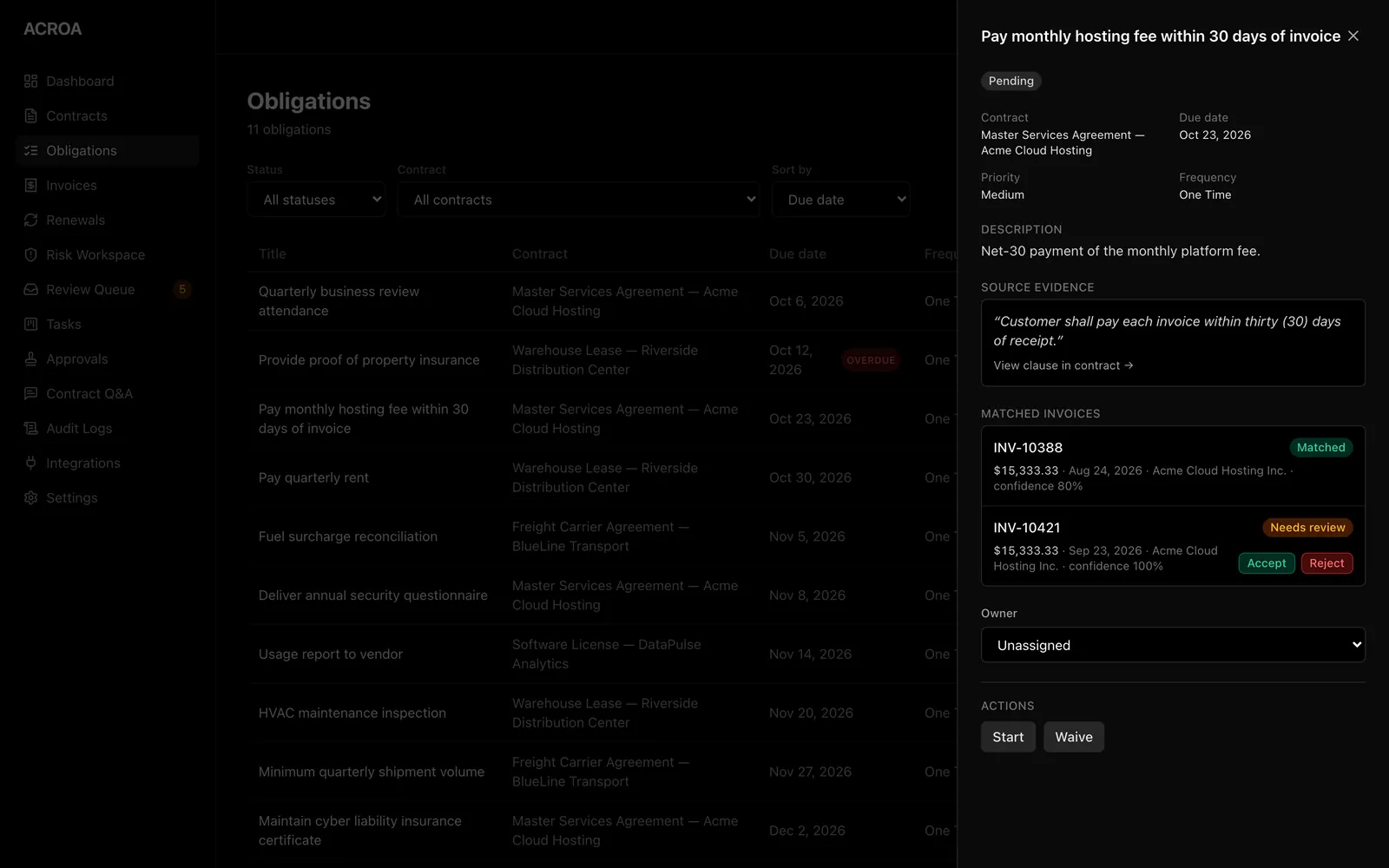
Hover to spread the screens, click one to look closer, orSwipe through the screens, tap one to look closer, or flip through all 6.
ACROA reads signed contracts, turns every obligation, renewal and notice window into a tracked workflow, raises risks before they cost money, and won't contact anyone outside the company without a person's approval.
- RoleLedgercross team project
- ContributionTeam effort
- Statusv1 delivered
- WhenSep – Oct 2026 · Ledgercross
In numbers
- confidence floor: anything below goes to a person
- 70%
- tables, every tenant row behind Postgres RLS
- 33
- Playwright specs, including a cross-tenant isolation sweep
- 23
- dates or amounts produced by the language model
- 0
The problem
A signed contract creates commitments: payments, reports, insurance certificates, notice deadlines and auto-renewals. Most of them are forgotten once the PDF is filed, and a missed 60-day notice window can lock a company into another year of a contract it meant to leave.
ACROA turns each contract into a live, monitored workflow, with a quote from the document behind every fact it tracks.
How it works
step through it · each step is a noteUnderstand, track, act
- 01A signed contract arrives by upload or from a synced Google Drive folder. Scans go through Document AI OCR.
- 02The model's only job is to find the wording: verbatim quotes with page numbers, never a date or an amount.
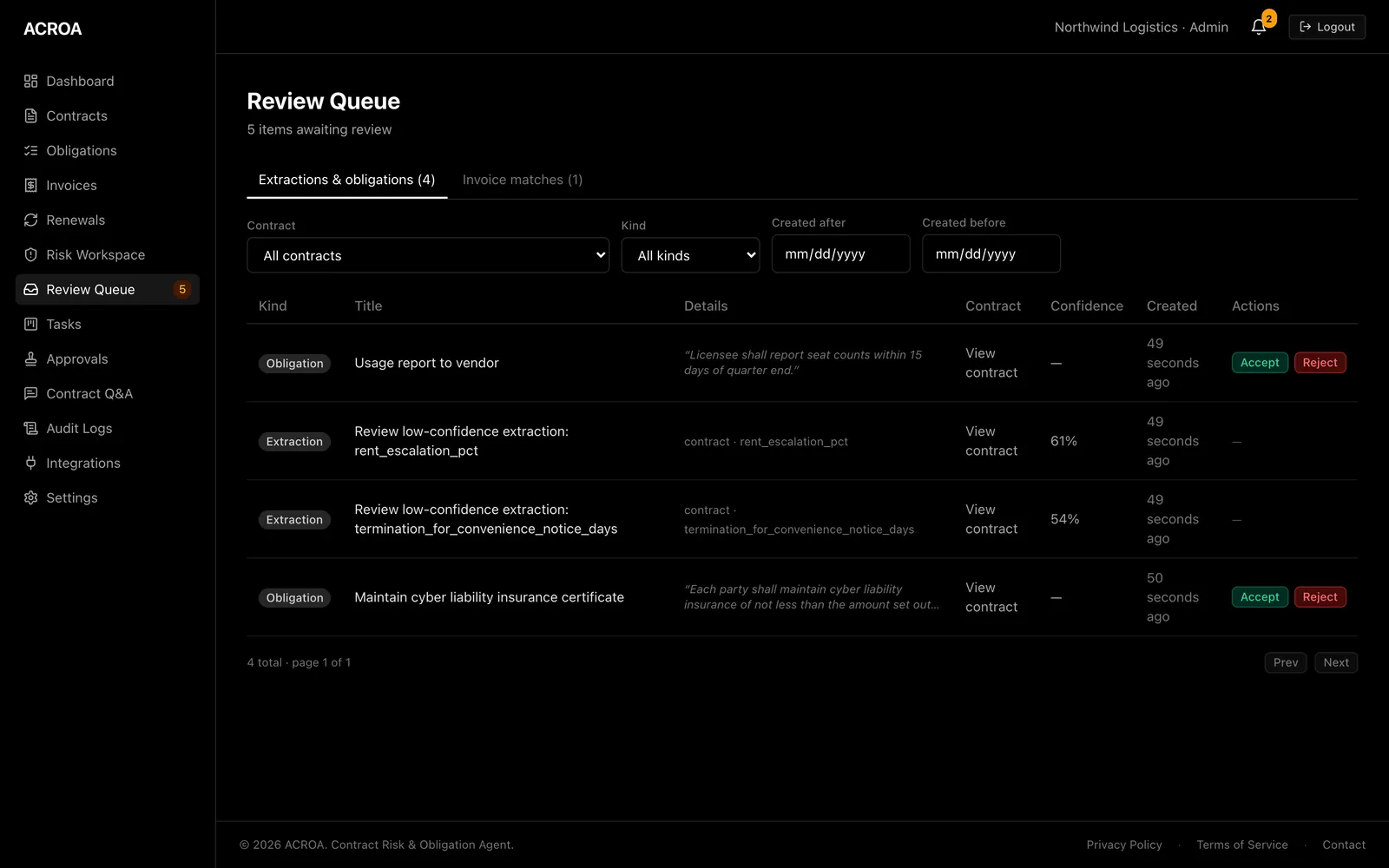
- 03Anything under 70% confidence, and any obligation the model proposes, waits for a person.
- 04A deterministic rule engine parses quotes into dates, money and notice deadlines. Same input, same answer.
- 05A daily sweep raises risk events: notice windows closing, overdue obligations, price caps exceeded.
- 06The agent drafts the next step, and a deny-by-default policy gate decides what it may do.
- 07Low-risk actions such as tasks and internal alerts run automatically.
- 08Anything external or high impact stops for a person, and every step lands in the audit log.
What the team built
Built by the Ledgercross engineering team.
- Contract ingestion from upload or a synced Google Drive folder, with Document AI OCR for scans.
- Extraction where the model returns only verbatim quotes and page numbers; a deterministic rule engine turns quotes into dates, money and notice deadlines.
- A daily monitoring sweep that raises risk events for closing notice windows, overdue obligations, compliance gaps and price-cap breaches.
- QuickBooks invoices matched to payment obligations by fixed rules, as evidence an obligation was met.
- Contract Q&A over hybrid vector and keyword search that cites a source for every sentence, or refuses.
- An agent behind a deny-by-default policy gate, with human approval for anything external or high impact and a full audit trail.
Decisions
Quotes from the model, values from code
The language model only finds wording. A rule engine parses the quote into a date or an amount, so the same contract gives the same answer every time, and anything the model says that isn't word for word in the document is discarded.
Deny by default
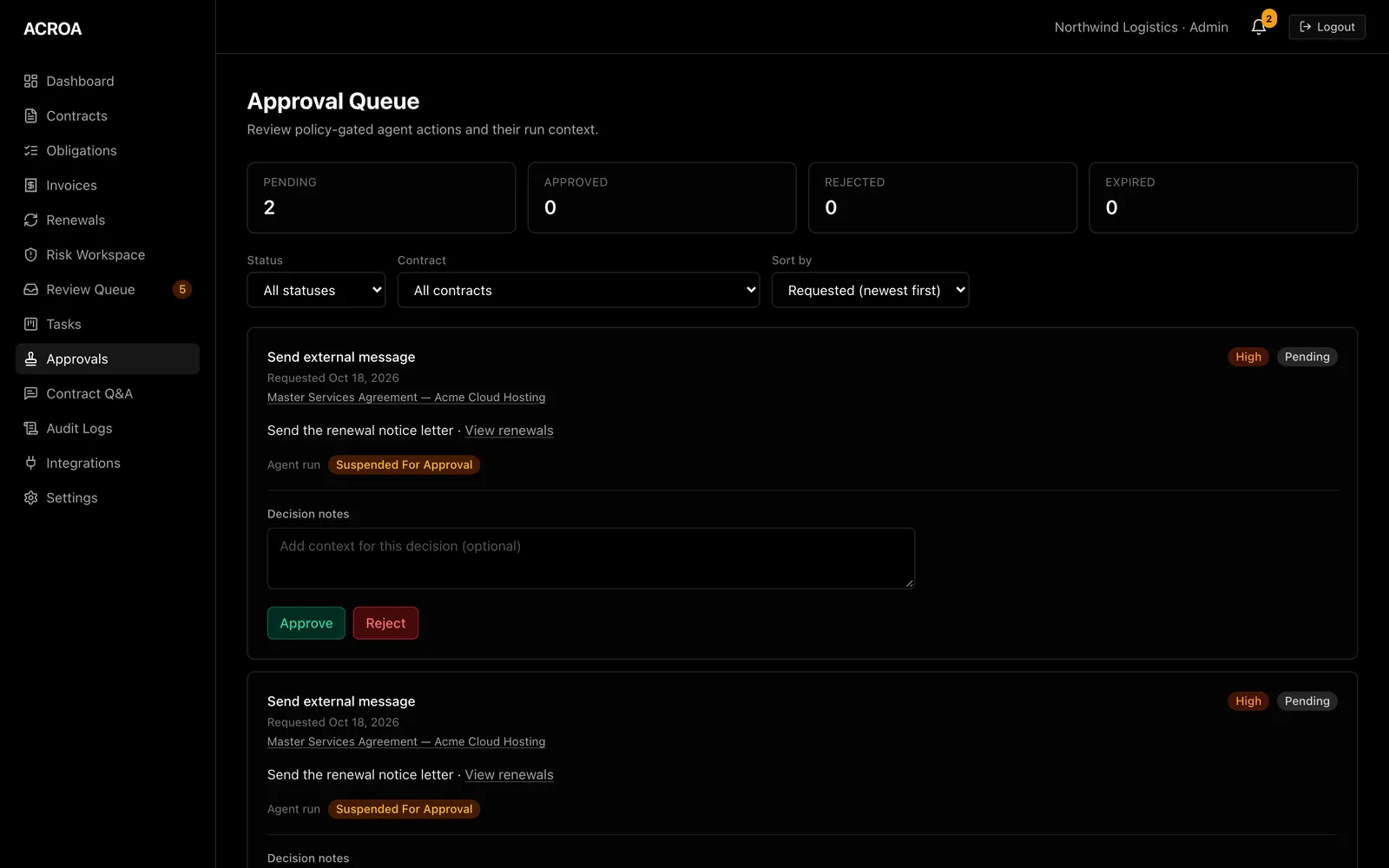
An agent tool exists only if it's registered and has a policy. Reading records and creating tasks run automatically; sending to a counterparty, resolving a risk or waiving an obligation stops for an approval.
Documents are untrusted input
Instructions hidden inside a contract or an email ("ignore previous instructions") are never acted on. Extraction outputs are schema-checked and quote-verified before they're stored.
Cited answers or none
Q&A answers carry a clickable citation per sentence. When the contracts don't support an answer, ACROA says so instead of guessing, and monitoring never reads dates from a chat answer.
Catching a renewal before it auto-renews
- 01From the renewal date and a 60-day notice period, the rule engine computes the deadline and reminders at T-90, T-60, T-30 and T-7.
- 02On 18 October the daily sweep sees 9 days left to give notice on an auto-renewing contract.
- 03It raises a critical risk event with its financial exposure and alerts the contract manager.
- 04The manager runs the agent, which reads the contract and drafts a non-renewal letter.
- 05Sending to a counterparty is high risk, so the agent suspends itself and asks an admin.
- 06Approved: the notice goes out, the renewal is marked notice served, and every step is in the audit log.
Stack
- BackendFastAPI, SQLAlchemy 2 async, Celery + Redis, Alembic
- Data & AIPostgreSQL 16, pgvector, Gemini, Document AI OCR, Langfuse
- IntegrationsGoogle Drive, QuickBooks Online, Clerk, Resend
- Web & opsNext.js 14, TanStack Query, Playwright, Hetzner + Dokploy, Cloudflare